Fillings
A filling closes the hole that decay has made in a tooth, so it doesn’t get bigger.
- Visits
- One, for a white filling
- Last updated

What it is
Tooth decay often causes no symptoms at first, which is why we usually find it at a routine check-up. While it is still on the surface, before a hole forms, it can be stopped with fluoride, as a varnish or a mouthwash, without a filling.
Once decay has made a hole in a tooth, you will usually need a filling. Left open, the hole grows and can lead to pain or an abscess. If the decay reaches the nerve in the middle of the tooth, you need root canal treatment instead.
Fillings today are white, matched to the colour of the tooth: a resin with fine particles of glass or ceramic, set hard with light. Amalgam, the “silver” filling, has not been used in the European Union since 2025, unless the dentist judges it strictly necessary for a particular patient.
How it is done
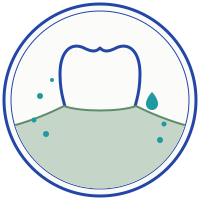
We numb the area
First a gel on the gum, then a local anaesthetic with a fine needle. You feel a scratch, then pins and needles in your lip. A small filling may not need an injection at all; we decide that together.
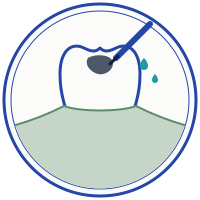
We clean out the decay
We remove only the decayed part, with fine instruments. It is noisy, and water keeps rinsing the tooth.
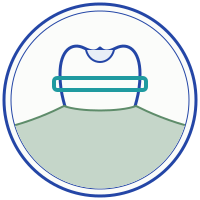
We prepare the tooth
The hole is clean now. Sometimes we put a thin band around the tooth to hold the shape of the filling; it can feel a little tight.
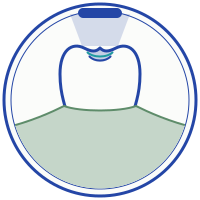
We place the white filling
The material looks like toothpaste. We put it in thin layers and set each one hard with a blue light.
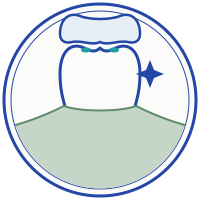
We check your bite and polish
You close your mouth so we can see that the filling meets the opposite tooth properly. We smooth off anything extra and polish it.
How long it lasts
A filling lasts a long time, but not forever. How long depends on where it is in your mouth, how big it is, how you bite and chew, and how you look after your teeth. We look at it at every check-up, and replace it only when it is worn, broken or has decay underneath.
What you will feel
Once the area is numb, what you notice is mostly noise, water and, if we use a band, a little tightness. If you feel pain, raise your hand: we stop straight away and ask before going on.
Afterwards
- Your lip and gum stay numb for a few hours. Until the feeling comes back, be careful not to bite your lip or cheek.
- The tooth may feel different at first; it usually feels normal again by the end of the day.
- For days or even weeks it may be sensitive to hot and cold. If it bothers you a lot, tell us; it can usually be treated.
- If the tooth touches first when you close, as if it were too high, call us and we will adjust it.
- To avoid needing another filling: brush twice a day with fluoride toothpaste, then spit without rinsing. Clean between your teeth every day, with floss or an interdental brush.
Where the steps come from
The steps and the aftercare on this page follow these patient information pages.